
5cm
Person to phone
A voice, a pause, a question that changes the brief. On the phone, the seller must earn the next minute by making the conversation about the client's world - not the vendor's pitch.

Deal Mechanics / Dean Kelly
AI prepares both sides. The conversation decides what survives.
5cm
A voice, a pause, a question that changes the brief. On the phone, the seller must earn the next minute by making the conversation about the client's world - not the vendor's pitch.
50cm
Teams or Zoom can connect a buying committee, but a shared screen is not shared conviction. Discovery must expose competing priorities, untested assumptions and the personal risk behind a polite nod.
500cm
In the room, the business case meets the people who must defend it. This is where value, trade-offs and the cost of doing nothing become a decision - or another reason to wait.
The seller arrives with AI-powered buyer preparation: company research, stakeholder hypotheses, competitive comparisons and a polished value story. The buyer arrives with AI-powered vendor evaluation, alternatives, price expectations and a view of what “good” should look like.
Neither arrives with the whole truth. Across these three distances, assumptions are improved, shattered or redefined. A researched account is not a discovered opportunity. A generated business case is not a customer-validated business case. A persuasive answer is not a commitment to change.
These conversations are now, more than ever, the sales battleground. The advantage is not who has the longest brief. It is who can uncover the business consequence, hear the hesitation and help the buyer make a decision they can defend.
The critical situation
The proposal is in. Procurement is pressing. The forecast is committed. Now the seller must defend a price - but the customer never validated the baseline, the cost of inaction or the value of the outcome. The discount looks like a negotiation decision. In Dean's white paper, it is the bill for discovery that was never completed.
Nothing, absolutely nothing, beats good & thorough discovery.
It is the key determinant of whether the deal is possible, likely or highly probable. These are evidence-led judgements, not promises or calculated win percentages.
There is a plausible problem and a reason to explore. Interest is not yet evidence of intent. Validate the baseline and ask: why change?
The customer confirms the consequence, urgency and stakeholders. The buying path is taking shape. Test: why now, and why this approach?
The value thesis is customer-validated, the decision process is understood, and stakeholders commit to a concrete advance. Protect that evidence through negotiation and delivery.
THE WHITE PAPER / DEAN KELLY
How discovery quality determines commercial outcomes before the first proposal is written.
Dean Kelly - the deal mechanic - Sales and Negotiation Coach
A White Paper for Chief Revenue Officers, Vice Presidents of Sales and Senior Commercial Leaders
Most commercial leaders believe discount decisions are made at the negotiation table. They are not. They are made in the first commercial meeting - in the questions the seller did or did not ask, in whether the customer or the vendor was the subject of the conversation, and in whether a business consequence was ever established. By the time procurement asks for 30 per cent off, the outcome has largely been decided. The negotiation simply reveals it.
The cost is material. Unplanned discounting leaks revenue and compresses margin on the first deal, then anchors every renewal, upgrade and expansion conversation that follows. In the author's field experience, as much as 20 cents of every revenue dollar is surrendered to mask discovery that was never completed.1 Worse, a solution sold on features is a solution that can be compared on price. Commoditisation is not imposed by the market; it is invited by the seller.
This paper offers senior leaders a diagnostic lens, not another training curriculum. It introduces the Five Flawed Handoffs, where discovery debt transfers and compounds across the sales cycle; the Discovery See-Saw, which links discovery quality to negotiation friction; the contrast between Level 1 (Product Qualification) and Level 2 (Outcome Architecture) discovery; the principle of Concession Economics; and the Discovery Debt Audit - five questions every leader should be able to answer before authorising any concession. Where the paper relies on peer-reviewed research, it says so. Where it relies on practitioner experience, it says that too.
The challenge is simple. Look at the last ten discounts your organisation approved. How many of them could you trace back to a question that was never asked in the first meeting?
Ask most sales leaders how they judge the health of their sales process and the answer arrives in the language of outcomes: win rate, quota attainment, pipeline coverage, average deal size. These are legitimate measures. They are also lagging ones. They record what happened without explaining why, and they quietly treat a won deal as proof of a good process.
1 Practitioner estimate. The figures of approximately 20 cents of revenue leakage on every dollar, and of 30 per cent or more of customer lifetime value being conceded, reflect the author's observation across enterprise and commercial sales organisations. They are not drawn from a published study and should be read as an informed estimate of scale, not a measured industry statistic.
That is the management illusion. A won deal proves only that a contract was signed. It does not prove that the deal was won at the value the customer was prepared to pay, that the seller understood why the customer bought, or that the commercial terms will survive renewal. An organisation that measures the output without auditing the inputs cannot distinguish a deal won on value from a deal rescued by discount. Both appear in the CRM as "Closed Won". Only one of them is repeatable.
The illusion persists because discovery competence is assumed rather than defined. Sales managers inherit sellers who "know how to run a discovery call", and the definition of a good first meeting - Meeting 1, or M1 - is left to individual interpretation. When "good" is undefined, it defaults to whatever the seller felt went well: the prospect was engaged, asked about the product and agreed to a next step. None of those signals confirms a business need, a measurable consequence or a reason to change now. When discovery competence is assumed, deals are exposed to hijacking at every later stage.
The consequence shows up in the pipeline. Under pressure to report qualified opportunities, sellers dress up meetings in assumptive language that papers over "Swiss-cheese" gaps in the data - solid on the surface, hollow underneath. The CRM captures the seller's interpretation of the meeting, not the customer evidence that would legitimise the stage progression. Forecasts are built on that interpretation. Discounts are later required to make it true.
The central question for commercial leadership is therefore not "Did we win?" It is "Did we deserve to win at full value - and do we know why we did?" A leader who cannot answer the second half of that question is managing results, not the behaviours that produce them. And behaviours, not results, are the only thing a sales leader can actually change.
Discovery is not a single event. It is a commercial discipline tested at every transition point in the sales cycle. Each handoff - between functions on the vendor side, or between the customer's champion and the buyer's own internal process - is a moment where unresolved discovery debt from the previous stage transfers forward and amplifies. A handoff creates no new information. It can only pass on what was learned, or pass on what was not.
The framework below identifies five such transitions. Read together, they explain why a discount requested in week twelve so often has its origin in week one.
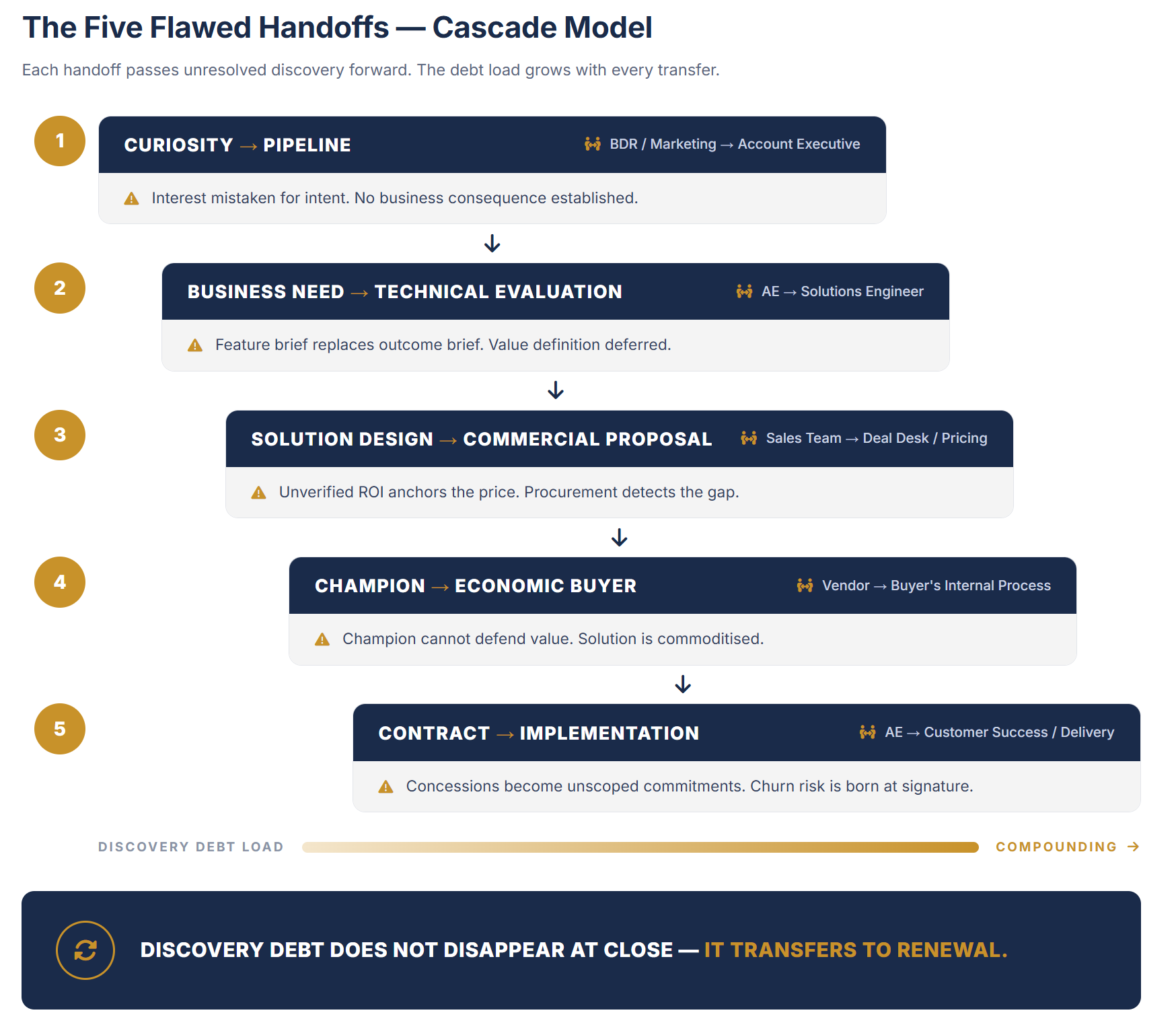
Dean Kelly's practitioner model, reproduced from the white paper. Illustrative, not a measured or predictive dataset.
DISCOVERY DEBT DOES NOT DISAPPEAR AT CLOSE - IT TRANSFERS TO RENEWAL.
| Parties | BDR or Marketing to Account Executive |
|---|---|
| Discovery failure | Expressed interest is mistaken for validated commercial intent. A meeting is booked and an opportunity created, but no business consequence has been established. Qualification checklists such as BANT² are completed on paper while the Three Whys - Why change? Why now? Why us? - remain unanswered. The AE inherits an activity, not an opportunity. |
| Negotiation consequence | The seller enters the cycle without a baseline. Every discovery question asked later is remedial - and the prospect knows it. If the early conversation went to product, "How much?" arrives before any value exists: a hospital pass from the first meeting straight to an uphill negotiation. |
2 Practitioner framework. BANT (Budget, Authority, Need, Timeframe) is a widely used qualification checklist that originated in industry practice rather than academic research. In the author's coaching experience, sellers asked to choose between a fully BANT-qualified meeting and a meeting with an executive whose budget is unknown consistently prefer the latter.
| Parties | Account Executive to Solutions Engineer or Architect |
|---|---|
| Discovery failure | The business rationale is never articulated before the technical capability tour begins. The SE receives a feature-oriented brief ("they want automated reporting and API integration") rather than an outcome-oriented one ("they need to close their monthly audit cycle in 3 days instead of 11, or the CFO faces a board covenant breach"). |
| Negotiation consequence | The proposal is built around a capability demonstration, not a business case. Price becomes the primary differentiator because value has never been defined. |
| Parties | Sales team to Deal Desk or Pricing |
|---|---|
| Discovery failure | Pricing is asked to construct a commercial proposal around unverified metrics and an unquantified return. The seller cannot substantiate the ROI claim because the customer has never been asked to validate it. |
| Negotiation consequence | Procurement recognises the weakness and applies pressure at the point of least substantiation - price. The seller concedes because there is no defensible anchor. |
| Parties | The vendor's champion to the buyer's internal process |
|---|---|
| Discovery failure | The champion cannot articulate the vendor's value thesis in internal meetings because the seller built the case for the champion rather than with the champion. The economic buyer arrives with no context and a mandate to reduce cost. |
| Negotiation consequence | The solution is commoditised by internal buying processes that were never pre-empted. The seller is not in the room and has no advocate who can defend value. |
| Parties | Account Executive to Customer Success or Delivery |
|---|---|
| Discovery failure | Post-sales teams inherit unmanaged expectations, undocumented commitments and concessions made under pressure that were never formally scoped. The "deal" that was signed and the "engagement" that was promised are different documents. |
| Negotiation consequence | Time-to-first-value slips, dissatisfaction registers and churn risk rises at renewal. The cycle then repeats - except the incumbent vendor is now negotiating from defended territory, not earned trust. |
The pattern across all five handoffs is consistent. Each is a test of whether discovery produced transferable evidence - customer-stated metrics, a quantified consequence, named stakeholders - or merely a seller's impression. Impressions do not survive handoffs. Evidence does.
The See-Saw model uses a children's playground image to make a commercial point. On one side sits the quality of opportunity discovery; on the other, the negotiation friction that must be overcome to win the deal. The more substantive the discovery, the lighter the concession load. The lighter the discovery, the heavier the discount required to tip the deal over the line.
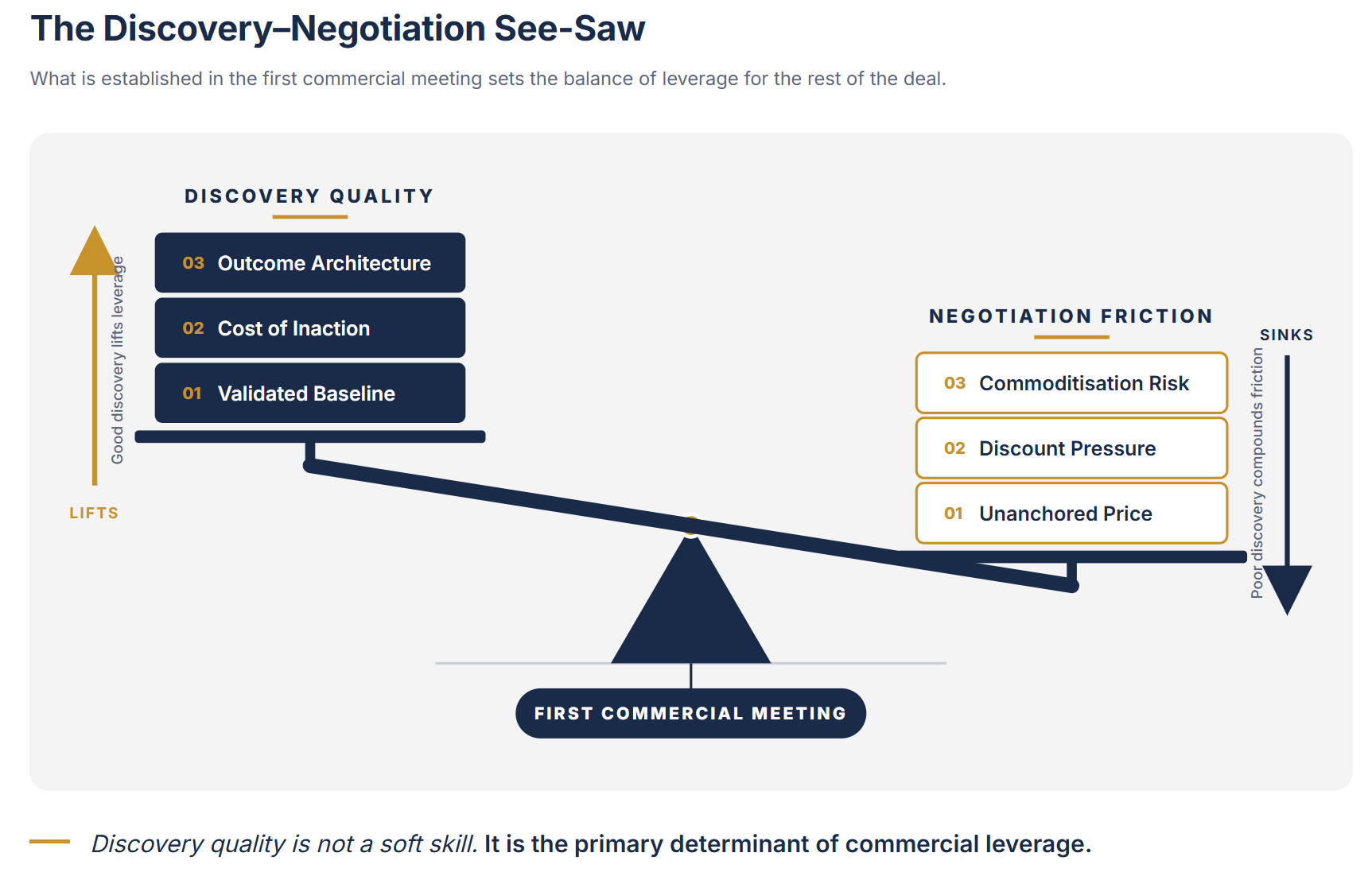
Dean Kelly's practitioner model, reproduced from the white paper. Illustrative, not a measured or predictive dataset.
Discovery quality is not a soft skill. It is the primary determinant of commercial leverage.
The model describes three levels of execution. Excellent execution - thorough discovery with extensive client metrics, sound qualification against all Three Whys and client-centric language in evidence - is associated with small or zero discounts (under 10 per cent), credit for value driven by measurable business outcomes, and relatively frictionless revenue growth. "Good" execution - clearly defined M1 conversations, explicit discovery requirements including the Three Whys, and no Sales Engineers in first meetings - is associated with medium discounts in the 15–30 per cent range and moderate renewal friction. Undefined execution - vague requirements, product-centric language and, typically, technical staff in the first meeting - is associated with major discounts of 35 per cent or more and a loss of business relevance.3
The See-Saw is not static. It is dynamic. Every week a deal sits in the pipeline without a validated business case, the negotiation burden increases. Stakeholders change, priorities shift, competitors are invited in, and the seller's early optimism hardens into a forecast commitment that must now be defended.
3 Practitioner model. The See-Saw and its discount bands (under 10 per cent, 15–30 per cent, 35 per cent or more) are the author's model, derived from coaching and field observation. The bands describe observed associations; they are illustrative, not empirically measured thresholds, and they do not establish causation.
Discovery debt is not neutral; it compounds. In the author's experience, critical data not captured in M1 is difficult and often impossible to recover later, because the window in which the customer will explore the problem openly has closed. Sales Engineers can help recover "honest data" later in the cycle, but recovery is always more expensive than capture.
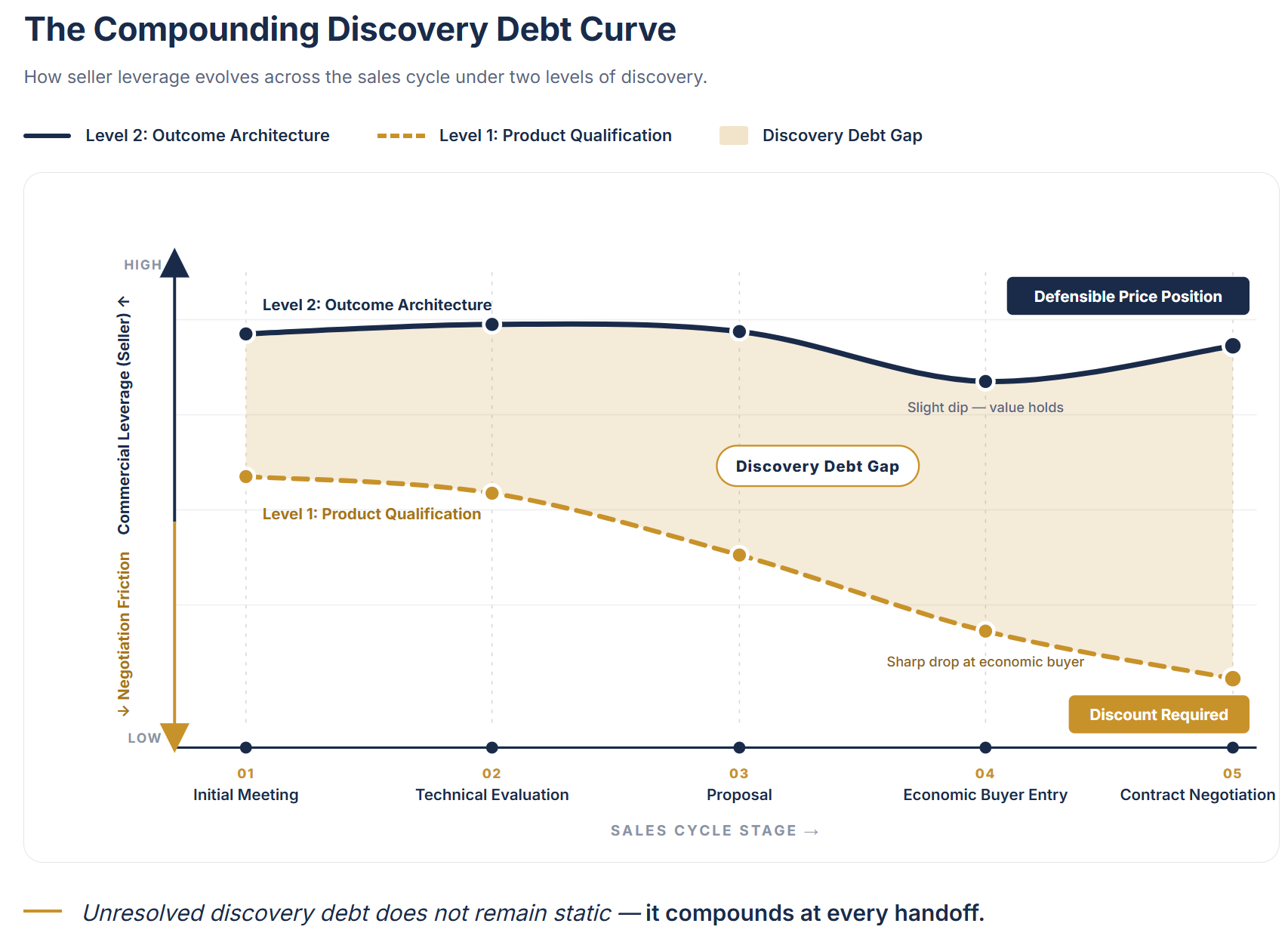
Dean Kelly's practitioner model, reproduced from the white paper. Illustrative, not a measured or predictive dataset.
Unresolved discovery debt does not remain static - it compounds at every handoff.
The decisive moment on the See-Saw is the Tipping Point: the stage at which the economic buyer enters the process. Before the Tipping Point, the seller controls the value narrative - the problem definition, the metrics that matter, the cost of inaction. After the Tipping Point, the procurement process controls the commercial frame - comparable vendors, standard terms, budget lines and price benchmarks.
This shift is consistent with peer-reviewed negotiation research showing that the first concrete reference point introduced into a negotiation exerts a disproportionate pull on the final outcome.4 If the seller has not established a value anchor before the economic buyer arrives, procurement will establish a price anchor instead. The test for leaders is blunt: in each late-stage deal, was the value thesis documented and customer-validated before the Tipping Point, or after it?
4 Peer-reviewed. Galinsky, A. D., & Mussweiler, T. (2001). First offers as anchors: The role of perspective-taking and negotiator focus. Journal of Personality and Social Psychology, 81(4), 657–669. The study concerns first offers in negotiation; applying it to value narratives established before procurement engages is the author's extension, not a tested finding.
Most organisations can tell whether a seller asked questions. Far fewer can tell what kind of questions they were. The distinction below gives commercial leaders a lens they can apply to their own call recordings immediately - no new methodology, only a different way of listening.
Level 1 discovery is vendor-centric. Questions orient toward what the customer needs so the seller can match it to a feature or capability. The seller feels productive, and call reviews focus on whether the right qualification questions were asked. Level 2 discovery is client-centric. Questions orient toward the business result the customer is trying to achieve, the cost of not achieving it, and who inside the customer organisation has a stake in the outcome. The seller may ask fewer questions, but each is weighted with strategic intent.
| Level 1: Product Qualification | Level 2: Outcome Architecture |
|---|---|
| ORIENTATION Vendor-centric: what does the customer need, so we can match it to a feature? | ORIENTATION Client-centric: what result must the customer achieve, and what does failure cost? |
| SUBJECT OF THE CONVERSATION The vendor's product and capabilities | SUBJECT OF THE CONVERSATION The customer's business, metrics and stakeholders |
| SAMPLE QUESTIONS • "What tech stack are you running today?" • "How many users would need access?" • "What workflows are you looking to automate?" • "Have you evaluated any other vendors?" | SAMPLE QUESTIONS • "If this initiative succeeds, which specific operational or financial metric moves - and by how much?" • "What is the cost to the business if you delay this by two quarters?" • "Who outside of your immediate team cares most about the outcome this project is meant to produce?" • "When you say this is a priority, help me understand - priority relative to what?" • "If you had to justify this investment to your CFO in one sentence, what would that sentence be?" |
| WHAT IT PRODUCES A demo, a proposal and a price | WHAT IT PRODUCES A business case, a negotiation position and a defensible price |
| COMMERCIAL RESULT Enough to pitch - not enough to negotiate | COMMERCIAL RESULT Enough to win at full value |
The difference is not courtesy or rapport. Level 1 gathers the information a vendor needs to configure a proposal; Level 2 gathers the information a negotiator needs to defend one. It also determines the altitude of the conversation - from "IT-speak" about feeds, speeds and process execution, through business-speak about efficiency and effectiveness, to executive metrics such as revenue growth, profitability, market differentiation, and market share won through customer acquisition and retention.
In the next call-review session, do not ask which questions were asked. Ask which mode the seller was operating in. If the answer is Level 1, the discount was authorised in that conversation.
As a seller walks into a first meeting, one question shapes much of what follows: who is the subject of the next thirty minutes? Is it the vendor, or is it the client? Most often, the vendor is the subject. The seller arrives to spend thirty minutes or more talking to the customer about the vendor - company history, solution roadmap, success stories, twenty or forty slides about us. The implications unfold like a slow-motion car crash.
The pattern intensifies when a Sales Engineer attends the first meeting. The conversation predictably becomes technical. The client anchors on the vendor's technology capability - which, in fairness, is what the vendor invited by bringing an engineer - and the seller loses the opportunity to understand the overarching business context, the current metrics of the problem, and the improvement that remediation would deliver. The customer is content to let the vendor keep talking about itself. The author calls this "naked selling": exposing everything about the vendor while learning almost nothing about the customer. The remedy is unglamorous - keep your clothes on by asking questions about them.
Even when the buyer is genuinely interested in the technology, a vendor-centred meeting leaves the seller unable to say which features, capabilities or outcomes resonated. Having thrown the features against the wall to see what stuck, the seller no longer knows what did. Nor did the seller create value in the client's mind - a picture of what is possible beyond the client's current thinking, informed by the vendor's experience solving the same problem for many others. The seller is caught at the first of the Three Whys, assuming that interest in a solution signals intent to buy. It is a massive assumption, and it returns to haunt the seller in the negotiation.
Peer-reviewed research supports the commercial relevance of customer-centred selling behaviour, while stopping short of proving the full causal chain this paper describes. In a multilevel study of 816 salespeople and sales directors across 30 sales organisations, Terho and colleagues found that salesperson customer orientation and value-based selling are mechanisms through which sales strategy translates into individual selling performance.5 Value-based selling - the degree to which a salesperson works with the customer to translate an offering's benefits into monetary terms, grounded in an understanding of the customer's business model - was conceptualised in earlier qualitative work by the same research group.6 In practice, that is Level 2 discovery.
5 Peer-reviewed. Terho, H., Eggert, A., Haas, A., & Uлага, W. (2015). How sales strategy translates into performance: The role of salesperson customer orientation and value-based selling. Industrial Marketing Management, 45, 12–21. The study tests mediating relationships within a multilevel model; it does not examine discovery practices or discount outcomes directly.
6 Peer-reviewed (qualitative, discovery-oriented study). Terho, H., Haas, A., Eggert, A., & Uлага, W. (2012). 'It's almost like taking the sales out of selling' - Towards a conceptualization of value-based selling in business markets. Industrial Marketing Management, 41(1), 174–185.
A second line of evidence connects understanding the customer directly to discounting. Alavi, Wieseke and Guba studied 537 salesperson–customer interactions and found that salespeople who accurately sensed how important price really was to a customer granted lower discounts - on average $616 less per transaction - while many salespeople misjudged price importance by relying on heuristic cues.7 The study was conducted in consumer automotive retail, not enterprise B2B, so extrapolation requires care. Its direction is nonetheless clear: sellers who understand the buyer give away less.
Practitioner frameworks reach similar conclusions through field observation rather than controlled study. SPIN-based selling distinguishes a meeting that ends in an "Advance" - a concrete commitment that moves the sale forward - from one that ends in a mere "Continuation".8 When the client is the subject, Advances become self-reinforcing. The seller earns a Meeting 2 with multiple stakeholders, referrals to others with a stake in the change or its timeframe, and the chance to test whether this contact is an economic buyer or a champion who will "bang the table" for the solution when the decision is made. In multi-stakeholder deals, the seller may run several M1s and herd buying stakeholders into one or more collective M2s, aligning the vendor's sales process with the customer's buying process.
There is a rule in selling that is widely observed and poorly understood: when we go to product, they go to price. It can be heard in inside-sales conversations and in any organisation that prizes the pitch. At the end of the twenty-slide presentation the customer asks, "How much?" The BDR defers to the account executive, who now inherits a price-negotiating first meeting with little chance to create value or even establish context.
What follows is the standard vendor negotiation. A standard proposal describes the vendor, its history, its solution and its stories, and how it proposes products and prices. It contains no understanding of differentiated value, or of where and how the vendor delivers unexpected value to this customer's business. When such a proposal meets professional procurement, the seller is a lamb to the slaughter. "Your competitor is 30 per cent cheaper" is met with a reflexive readiness to drop the price.9
In that moment, the discount is not a negotiating tactic. It is a repair mechanism, applied to compensate for poor execution earlier in the sales process. In parts of the software sector, discounting has become so routine that it is almost accepted practice. That normalisation is itself an admission of the problem. It ignores the effect of discounting on customer trust, on the anchoring of every future negotiation, and on the upgrade, expansion and renewal conversations that drive lifetime value and recurring revenue. That normalisation is reinforced from inside the selling organisation, too. Many companies justify the discount internally as the thing that secures the deal before month-end or quarter-end, so the concession is not merely tolerated but condoned, and in time reported as accepted practice.
Concession Economics rests on one principle: every concession at the negotiation table has a discovery antecedent. Concessions are not random acts of buyer pressure. They appear where the seller's case is weakest, and the seller's case is weakest wherever discovery was incomplete.
7 Peer-reviewed. Alavi, S., Wieseke, J., & Guba, J. H. (2016). Saving on discounts through accurate sensing - Salespeople's estimations of customer price importance and their effects on negotiation success. Journal of Retailing, 92(1), 40–55. The data come from business-to-consumer automotive retail. The finding is correlational evidence from a multilevel field dataset and is cited here as directional support, not as a B2B benchmark.
8 Practitioner model. Rackham, N. (1988). SPIN Selling. The Advance/Continuation distinction derives from large-scale observational research on sales calls, published for practitioners rather than through academic peer review.
9 Practitioner source. See the author's companion article, 'How to Handle a Price Objection from Procurement'.
| Concession type | Discovery antecedent | Question that should have been answered |
|---|---|---|
| Price | Unquantified value | What measurable return will this deliver? |
| Scope | Unvalidated requirements | Which requirements has the customer confirmed? |
| Term | Undefined urgency | Why now - and what does delay cost? |
| Payment | Unverified budget process | How is this funded, and who approves it? |
For the VP of Sales, the implication is direct. Tightening discount-approval thresholds treats the symptom. To reduce unplanned discounting, audit the discovery inputs - not the approval process. A concession request that cannot be traced to a validated baseline, a quantified cost of inaction and a confirmed budget process is not a negotiation problem. It is a discovery problem that has arrived late.
The Discovery Debt Audit is a governance tool for CROs and VPs of Sales to use in deal-review sessions. It is deliberately short. It is not designed to help a seller justify a discount; it is designed to determine whether the seller has earned the right to discuss commercial terms at all.
Executive Scorecard for Deal Review
Before authorising any commercial concession, a sales leader should be able to answer yes to all five of the following questions. If the answer to any question is "no" or "I'm not sure", the seller has not completed discovery. The discount request is premature.
1. Customer-Validated Baseline. Can the seller state the customer's current operational or financial baseline - in the customer's own words, not the seller's interpretation?
2. Cost of Inaction (COI). Has the economic sponsor articulated - explicitly and on record - the commercial or strategic cost of doing nothing? Not the cost of choosing a competitor: the cost of choosing to delay.
3. Approach Trade-offs Presented. Did we present multiple commercial Approaches to the customer, or a single binary package? A customer who has evaluated Approaches has made a choice. A customer who received one proposal has received a price to negotiate.
4. Concession Economics Applied. Is every concession requested by the customer matched with a corresponding trade from the customer - in payment timing, contract term, scope adjustment, reference commitment or case-study participation? If the seller is giving without receiving, they are not negotiating. They are capitulating.
5. Delivery Alignment Confirmed. Have the delivery and customer success teams confirmed that the scope being promised at the proposed price is commercially and operationally viable? If post-sales teams would not sign off on this deal at this price, the seller is building a future churn event.
| 5 of 5 | Negotiate with confidence. |
| 3–4 of 5 | Return to discovery before proceeding. |
| 0–2 of 5 | The deal is not ready for commercial terms. |
The Audit belongs before a request reaches the approval workflow, not after it. Applied consistently, it turns deal review from a haggle over a percentage into an inspection of evidence - and it tells the seller, in advance, exactly what evidence will be inspected.
When a sales manager has defined "good" discovery, and the team has agreed what a good M1 looks like, the sales process starts differently. The SE does not attend M1 and is engaged only once the opportunity qualifies against all Three Whys - or, at minimum, Why change? and Why now? The meeting opens with a customer-centric conversation, spends appropriate time on the Three Whys, captures defined key metrics, and includes a basic trial close on implicit versus explicit need to change. The intended outcome - an Advance, and the specific next step in the buying process - is decided before the meeting begins. Three imperatives follow.
1. Redefine what "good discovery" looks like. Judge discovery not by the questions asked but by the outputs produced: a validated baseline, a quantified cost of inaction, a named economic sponsor and a mapped internal buying process. If those outputs are absent, discovery is not complete, however long the call.
2. Move the discount conversation upstream. Shift it from the approval workflow to the pipeline review. The question is not "Should we approve this discount?" It is "Should we be at commercial terms yet?"
3. Build a discovery standard that travels. Define a minimum viable discovery output that every deal must meet before a proposal is written, and that survives every handoff. This is a commercial governance decision, not a sales training initiative.
Beyond "good" lies a higher standard. What if sellers held themselves accountable for getting inside the client's business - improving operating efficiency, enabling go-to-market differentiation, contributing to market share gain - as a trusted advisor rather than a supplier? At that level, negotiation changes character. The client is no longer negotiating against the vendor but with it, choosing between Approaches that deliver different levels of return: invest $1 to get $1.50 back, invest $1.35 to get $2.50 back, or invest $1.75 to obtain a $4.00 return. It is no longer vendor versus client. It is partners contributing to, enabling and executing a business strategy.
For boards and shareholders, the question is equally pointed. Customers are the source of future revenue and, ultimately, of valuation. If - as the author's field experience suggests - 30 per cent or more of customer lifetime value is being given away to mask poor discovery, undefined sales behaviours and the absence of any negotiation process, that is not a sales-performance issue. It is a value-preservation issue. Imagine the effect on brand and margin if discovery became the real competitive battleground, the sales orientation became genuinely customer-centric, and reflexive discounting stopped.
Every organisation that struggles with margin believes the problem lives at the end of the sales cycle - in procurement's tactics, in a competitor's pricing, in a market that has learned to wait for the quarter-end discount. It does not. It lives at the beginning: in first meetings where the vendor was the subject, in handoffs that transferred impressions instead of evidence, and in pipeline reviews that asked whether a deal would close rather than whether it deserved to. The answer to your discount problem is not a tighter approval matrix or a sharper negotiation script. It is already sitting in your pipeline, in the conversations your sellers are having this week. You have simply been looking at the wrong end of the deal.
This paper deliberately separates what has been tested in peer-reviewed research from what is drawn from practitioner experience. The table below classifies each source by evidence type, so that readers can weigh each claim accordingly.
| Source | Evidence type | Setting | Used to support |
|---|---|---|---|
| Terho et al. (2015) | Peer-reviewed, quantitative | 816 salespeople, 30 B2B sales organisations | Customer orientation and value-based selling drive performance |
| Terho et al. (2012) | Peer-reviewed, qualitative | B2B markets | Definition of value-based selling |
| Alavi, Wieseke & Guba (2016) | Peer-reviewed, quantitative | 537 interactions, consumer automotive retail | Understanding the buyer reduces discounts |
| Galinsky & Mussweiler (2001) | Peer-reviewed, experimental | Negotiation studies | First reference points anchor outcomes |
| Rackham (1988) | Practitioner, observational | Field sales calls | Advance vs. Continuation outcomes |
| Author's See-Saw model and estimates | Practitioner, coaching experience | Enterprise and commercial sales | Discount bands; revenue-leakage scale |
Where the paper links discovery quality directly to discount outcomes, it does so on the strength of directional research evidence combined with practitioner observation. Leaders who want causal proof in their own organisation have the means to produce it: score discovery quality with the Discovery Debt Audit and compare it with realised discount levels across a quarter of closed deals.
DOWNLOAD THE FULL WHITE PAPER
The next move
Let's review your pipeline, assess your critical deals, and build a strategy that protects your revenue.
Book a 30-minute strategy callNo pitch. No obligation. Just a focused conversation about your most pressing deal challenge.